(855) 369-9993

Divorce Attorney in Venice, California

Venice divorces often involve canal property, creative royalties, Silicon Beach equity, and pre-marriage Marvin claims. Duncan Family Law represents Venice clients in divorce, custody, domestic partnership dissolution, and complex property division. Nicole Duncan, Esq. handles every matter directly.

Schedule a Consultation
Tell us briefly what you're facing. A member of our team will follow up regarding next steps.
Submitting this form does not create an attorney-client relationship.

Venice Divorce Counsel

Divorce Attorney in Venice, California | Duncan Family Law

Venice does not produce conventional marriages.

Along the six historic canals of the Venice Canal Historic District, Carroll, Eastern, Linnie, Howland, Sherman, and Grand, and through the walk streets where pedestrian paths replace roads, families build lives that look different from the rest of Los Angeles.

On Abbot Kinney Boulevard, in the Silver Triangle, in the Oakwood neighborhood where Google’s Main Street offices anchor the Silicon Beach technology corridor, and in the creative studios of Windward Circle and the North of Rose corridor, couples build lives, start businesses, form families, and sometimes reach the decision to separate.

Venice divorces often involve financial structures as unconventional as the neighborhood itself. One partner holds pre-IPO startup equity at a Silicon Beach employer. The other is a filmmaker or musician whose income arrives in irregular project payments and royalties.

They lived together for six years before the wedding, buying a canal house on Grand Canal Court during that time. Their family was formed through surrogacy. Now they are separating.

Protecting each partner’s financial position, their children’s stability, and the decades of work they have built into that canal property requires legal analysis that does not fit a template.

Duncan Family Law represents Venice residents in divorce, domestic partnership dissolution, contested custody, Marvin cohabitation claims, and complex property division. The firm’s Beverly Hills and Los Angeles offices serve Venice clients; Nicole appears at the Stanley Mosk Courthouse where Venice dissolution matters are heard. For couples who prefer a private, negotiated resolution, the firm also serves as a trusted divorce lawyer Venice residents turn to.

Venice divorces rarely follow a standard script. Neither does our approach. Call Duncan Family Law at (855) 369-9993 for a confidential consultation with attorney Nicole Duncan.

Who We Help

Is Duncan Family Law Right for Your Venice Divorce?

This firm is built for cases where the facts are specific, and the financial issues are real. You may be a strong fit if your Venice divorce involves:

  • A relationship that predated the legal marriage, and years of shared property during that pre-marriage period
  • Creative income: royalties, licensing fees, residuals, commissions, or variable project-based earnings
  • Tech equity: RSUs, startup shares, pre-IPO preferred stock, or a founder’s interest in a Silicon Beach company
  • Canal district or walk-street property, Venice Canals, Silver Triangle, Presidents’ Row, Milwood, or Sand Section
  • A registered domestic partnership, either through the City of Los Angeles or the California Secretary of State
  • An LGBTQ family formed through surrogacy, assisted reproduction, or co-parenting arrangements
  • Child custody disputes involving parentage establishment, relocation from Venice, or school enrollment logistics
  • Separate property you need to protect, a canal house bought before the wedding, a creative catalog built before the relationship

Early Counsel Matters

Acting Before the Other Side Does: Why Early Counsel Matters in Venice

In a Venice divorce involving canal property with a complex ownership history, creative royalty streams that predate the marriage, or a pre-marriage cohabitation period with intertwined finances, the analysis conducted before any petition is filed is often the most consequential.

Documenting the source of the canal house down payment. Preserving the royalty accounting records. Establishing whether the startup equity grant was made in contemplation of past or future services, and how much of the vesting period falls within the marriage.

These determinations set the financial framework for everything that follows.

Acting early also means understanding whether a Marvin claim exists from the pre-marriage period. These claims are time-sensitive, fact-intensive, and require early legal analysis to pursue effectively.

They cannot be retroactively added late in the dissolution without specific procedural steps.

For Venice couples whose financial entanglement began long before the wedding, waiting to consult an attorney until after the petition is filed may mean losing the ability to assert property rights from the most financially significant period of the relationship.

About Attorney Nicole Duncan

Venice Divorce Attorney Nicole Duncan, Esq.

Duncan Family Law is founded and led by Nicole Duncan, Esq.  Nicole regularly appears at the Stanley Mosk Courthouse, 111 N. Hill Street, Los Angeles, where Venice dissolution matters are heard.

Her business training supports direct engagement with creative income reconstruction, Silicon Beach equity analysis, and the forensic financial work Venice cases frequently require. She is also recognized as a dependable divorce attorney in Venice for couples seeking a private, negotiated resolution.

Marvin Claims & Cohabitation

Cohabitation, Pre-Marriage Property, and Marvin Claims in Venice

Venice has always attracted couples who built lives together before building legal ones.

Many Venice residents lived together on Windward Avenue, in the Oxford Triangle, or in a shared canal house for five, eight, or ten years before they married, purchasing property, building creative businesses, and intertwining their finances in ways that California’s community property system simply does not address, because that system begins only on the date of legal marriage or domestic partnership registration.

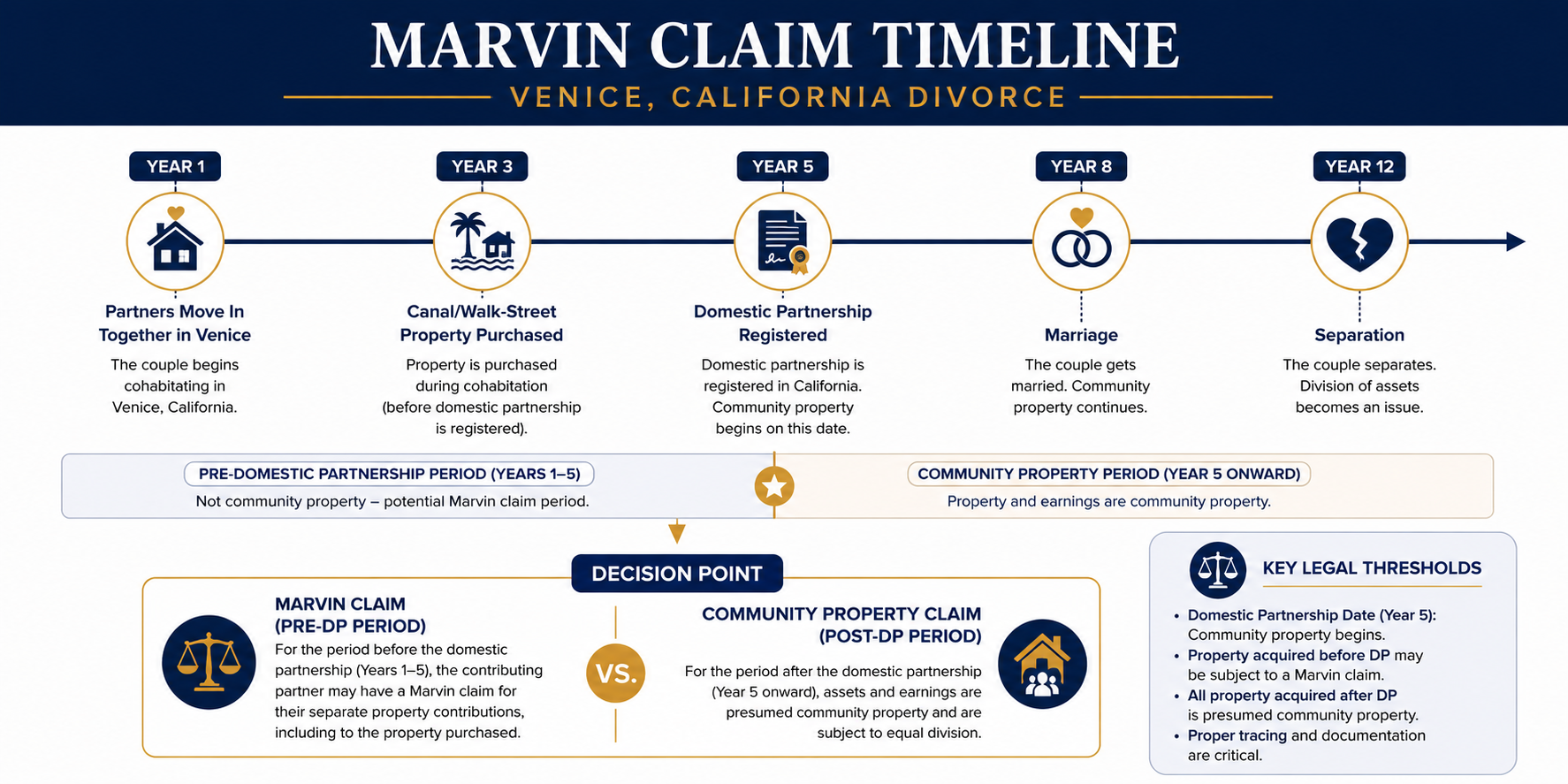
Consider a representative Venice scenario: two partners meet and move in together in 2011. In 2014, they purchase a walk-street cottage together in Milwood, using one partner’s savings from before the relationship and the other’s income during the shared period.

They register as domestic partners in 2016, then marry in 2019. They separate in 2025. The community property analysis applies only from 2016 (domestic partnership) or 2019 (marriage). The 2014 walk-street purchase falls entirely in the pre-legal-recognition period.

Without a Marvin claim or a specific pre-partnership agreement, the partner who contributed to the purchase during the cohabitation period may have no recognized legal claim to that equity, unless the legal analysis is done early enough to preserve it.

Marvin Claims Defined

What is a Marvin Claim?

In Marvin v. Marvin (1976), the California Supreme Court recognized that unmarried cohabitants may assert property rights based on an express or implied contract to share property during the relationship, or under unjust enrichment principles where one partner received an unfair benefit at the other’s expense.

Marvin claims are litigated separately from the dissolution itself; they are not automatically part of the divorce proceeding. They are fact-intensive, require specific evidence of agreement or contribution, and have a statute of limitations that makes early legal analysis essential.

If your Venice relationship involved years of pre-marriage cohabitation during which property was acquired or financial contributions were made, a Marvin analysis should be part of the first consultation.

California property claims timeline infographic

Common Asset Categories

Income and Asset Types Common in Venice Divorce Cases

The following table summarizes the most common income streams and assets in Venice divorce cases, the key characterization issues each raises, and the analysis required:

Asset / Income Type Common Venice Context Characterization Issue Analysis Required
Canal / Walk-Street Property Venice Canal Historic District, Silver Triangle, Milwood Premarital purchase? Commingled funds? §2640 reimbursement? Moore/Marsden; §2640 tracing; current appraisal
Creative Royalties / Residuals Musicians, writers, directors, visual artists Work created during marriage = community; pre-marriage = separate Royalty statement analysis; present value calculation
Intellectual Property (Copyright) Songwriters, authors, software developers Community if created with marital effort; separate if premarital IP ownership review; income stream valuation
Silicon Beach Startup Equity Google employees, startup founders, engineers Time-rule allocation; startup valuation methodology In re Marriage of Hug analysis; CBA valuation if private
Marvin Cohabitation Property Pre-marriage co-purchased assets Express or implied contract; unjust enrichment Evidentiary analysis; Marvin claim pleading
Domestic Partnership Interest Registered domestic partners (CA SoS) Same as marriage from date of registration Registration date confirmation; FC §§297-299.6
Live/Work Space / Studio Artists, designers, photographers Business asset or personal use? Mixed character? Business vs. residential characterization; appraisal
Variable Freelance Income Creative and tech consultants Multi-year average; earning capacity analysis Forensic income reconstruction; 3-5 year average

A Case Example

A Practical Venice Example

Consider a couple from Venice who have been together since 2013. One partner is a music producer whose catalog, developed primarily before 2018, when they legally married, now generates $180,000 in annual streaming and licensing royalties.

The other is a lead engineer at a Silicon Beach company near Main Street, holding $1.2 million in unvested RSUs across three grant cycles, two of which began before the marriage and one of which was granted the year after the wedding.

This dissolution raises at least four distinct financial questions that each require specific analysis: (1) What portion of the music catalog royalties is community property, given that the underlying works were primarily created before the legal marriage, though the catalog was actively marketed during the marriage using community funds?

(2) How is each RSU grant allocated using the time-rule formula from In re Marriage of Hug, given that the grants span different periods relative to the 2018 marriage?

(3) Did the couple’s pre-2018 cohabitation period generate any Marvin claims from assets acquired together before the legal marriage?

(4) How does the couple’s Oakwood home, purchased in 2015 during the cohabitation period, with a down payment from the producer’s pre-relationship savings, get treated in the dissolution?

In this case, protecting each partner’s financial future requires answering all four questions correctly from the first disclosure. A settlement that treats the music catalog and the RSUs as equally divisible community assets without performing the underlying analysis is not a settlement. It is an expensive mistake.

If your Venice divorce involves creative income, a canal property, startup equity, or a pre-marriage cohabitation period, the financial analysis starts before any negotiation. Call (855) 369-9993.

Venice Neighborhoods

Divorce Across Venice’s Neighborhoods
The Venice Canal Historic District

The six historic canals of Venice, Carroll, Eastern, Linnie, Howland, Sherman, and Grand, are home to approximately 450 residences on pedestrian-only pathways.

Canal-facing properties trade between $2.8 million and $6 million or more; rare double-lot or fully renovated homes command higher prices. Canal properties rarely sit on the market for more than 20 days when priced correctly.

In a divorce, the canal house is usually the most significant financial asset and the most emotionally significant decision.

A canal property purchased during the marriage is straightforwardly community property, subject to equal division under Family Code § 2550, but the capital gains exposure on a property that has appreciated by $2–3 million since purchase must be analyzed before any sale or buyout agreement is signed.

Where a separate-property down payment was made, a Family Code § 2640 reimbursement claim must be established by tracing before the community equity figure is meaningful.

Silver Triangle and Presidents’ Row

The Silver Triangle, the residential pocket bounded by the Venice Canal Historic District to the east and the Pacific Ocean to the west, is one of Venice’s most competitive micro-neighborhoods, with a concentration of higher-end single-family homes on quieter residential streets within walking distance of both the canals and the beach.

Presidents’ Row, named for its streets (Lincoln, Washington, and others), features a mix of original bungalows and architecturally significant modern homes. Both neighborhoods carry the Venice premium: proximity to the beach, the canals, and Abbot Kinney Boulevard.

Divorces in Silver Triangle frequently involve long-term appreciation, renovation investments funded with community income, and the valuation complexities that arise when a property has been substantially altered from its original condition.

Oakwood and the Silicon Beach Corridor

Oakwood, one of Venice’s largest residential neighborhoods, stretching inland from the beach toward Lincoln Boulevard, is home to Google’s Venice offices on Main Street and the broader Silicon Beach technology ecosystem.

The neighborhood’s mix of original California bungalows and newer architectural homes attracts engineers, product managers, and technology executives whose compensation packages include significant equity.

Oakwood divorce cases frequently involve RSU and startup equity division alongside real estate disputes, and the geographic proximity to Google’s campus and the growing network of tech companies along Hampton Drive and Main Street means that the equity compensation issues that define Silicon Beach divorces are as present in Oakwood as anywhere on the Westside.

Abbot Kinney Area and Oxford Triangle

The residential streets surrounding Abbot Kinney Boulevard, Venice’s most recognized commercial corridor, and the small, well-defined Oxford Triangle pocket command a premium for walkability and access to lifestyle amenities.

Creative professionals, entrepreneurs, and entertainment industry executives populate these streets.

Income in these households is frequently non-traditional: a creative director at a Venice-based agency, a gallery owner, a freelance photographer, a podcaster with platform income, none of whose earnings fit a standard W-2 analysis.

For support purposes, the forensic income reconstruction required in Abbot Kinney area divorces almost always requires analysis of multiple years of tax returns, platform revenue statements, project invoices, and contract records to establish a reliable income baseline.

Windward Circle and North of Rose

Windward Circle, where Windward Avenue meets Main Street, near Venice’s iconic colonnades, is home to artists, entertainment industry professionals, and the creative businesses that define Venice’s cultural identity.

The North of Rose corridor, between Rose Avenue and the Santa Monica border, offers Venice living at a price point slightly below the canal district and Silver Triangle, attracting young families, dual-income creative households, and tech workers who want Venice’s character without the canal premium.

Divorces in these neighborhoods frequently involve rental properties (Venice’s rental market is among the tightest in Los Angeles), creative business interests, and custody disputes shaped by the LAUSD school enrollment logistics of a neighborhood served primarily by LAUSD zoned schools and a competitive magnet and private school market.

Family Law Services

Divorce and Family Law Services for Venice Residents
Property and Asset Division

Community property is divided equally under Family Code § 2550.

In Venice cases, the community estate typically includes: canal and walk-street real estate, creative industry royalties and IP, tech equity compensation, business interests in creative or technology companies, and investment accounts.

Separate property tracing is required wherever property was acquired before the marriage or domestic partnership, or received as a gift or inheritance.

Spousal Support

Venice creative and tech households often feature wide income disparities and highly variable earnings. California Family Code § 4320’s fourteen factors apply in every case.

For creative professionals with irregular income, multi-year forensic income reconstruction establishes the accurate support baseline.

For tech executives, the time-value of unvested equity must be factored into the true income picture.

Domestic Partnership Dissolution

California Family Code §§ 297–299.6 grant registered domestic partners the same rights as married spouses. A simplified termination option is available for partnerships that meet specific criteria.

Importantly, registration with the City of Venice or the City of Los Angeles alone does not confer the full statewide legal rights conferred by registration with the California Secretary of State. Confirm registration status before assuming full marital-equivalent rights apply.

Child Custody

For LGBTQ Venice families, the parentage foundation must be established before child custody can proceed.

Pre-birth parentage judgments, UPA determinations under Family Code §§ 7600–7730, and Assisted Reproduction Act considerations under §§ 7960–7962 each apply depending on how the family was formed.

Venice school enrollment (LAUSD neighborhood schools, magnet programs, and private options in nearby Santa Monica) is a central logistics issue in the parenting plan. Relocation disputes require immediate action.

Domestic Violence Restraining Orders

The DVPA applies equally to marriages, domestic partnerships, and dating relationships. Venice domestic violence restraining order are heard at the Stanley Mosk Courthouse.

Mediation

Many Venice divorces, particularly those involving mutual creative or professional investments where ongoing collaboration may continue post-dissolution, resolve through mediation or negotiated settlement. Duncan Family Law prepares clients for both processes with equal rigor. Couples exploring this route often look for an experienced divorce lawyer Venice families already trust to guide the process.

The Divorce Process

How to File for Divorce in Venice, California

Venice is a neighborhood within the City of Los Angeles, in Los Angeles County (ZIP codes 90291 and 90292). Divorce proceedings are filed with the Los Angeles County Superior Court, heard at the Stanley Mosk Courthouse, 111 N. Hill Street, Los Angeles.

Under Family Code § 2320, at least one spouse must have resided in California for a six-month period and in Los Angeles County for three months before filing.

Common Divorce Mistakes

Common Mistakes in Venice Divorce Cases
  1. Assuming the pre-marriage period is financially irrelevant: Assets acquired during a long cohabitation may be subject to Marvin claims. These claims have a statute of limitations and require early legal analysis.
  2. Treating a domestic partnership registered only with the City of Venice as equivalent to a state-registered partnership: City-level registration does not confer the full statewide legal rights of California Secretary of State registration. Confirm the scope of your registration before assuming full marital-equivalent rights apply.
  3. Dividing creative royalties based on last year’s income alone: A single year’s royalty income is not a reliable basis for division. The present value of the future royalty stream, based on multi-year royalty history, contract terms, and income projection, is the correct figure to negotiate around.
  4. Selling or exercising startup equity without tax and legal analysis: Options exercised during the divorce without review can create unexpected tax liabilities and compromise the characterization of the remaining unvested equity.
  5. Not addressing parentage before the custody proceeding: In Venice LGBTQ family custody cases, unresolved parentage means the custody proceeding cannot proceed correctly. This is a first step, not a formality.

Begin

Contact a Venice Divorce Attorney

The first step is a direct, confidential conversation about your specific situation, your assets, your relationship history, your children’s needs, and what a realistic outcome looks like under California law. Duncan Family Law is built for exactly the cases Venice produces. Our Venice divorce attorneys are also available if a negotiated resolution is the better path for your family.

Every divorce changes a family. The objective isn’t simply to finish the case; it’s to protect your children, preserve your financial future, and position you for the next chapter of your life. For couples who prefer negotiation over litigation, our Venice divorce lawyers can help determine whether that path fits your situation.

Whether your Venice divorce involves a canal house, creative income, startup equity, a domestic partnership, or a family formed outside conventional structures, Duncan Family Law provides strategic representation built around what matters most to you.

Call Duncan Family Law at (855) 369-9993. Confidential consultations for Venice and all of Los Angeles County.Duncan Family Law, Beverly Hills office: 468 N Camden Dr, Beverly Hills, CA 90210.

Google Review

“From the initial consultation through the final hearing, Duncan Family Law was outstanding. Nicole is organized, knowledgeable, and fearless in court. I recommend her without hesitation.”

Moncef A.

Google Review

“Nicole Duncan is an outstanding family law attorney. She helped me navigate a complicated divorce and custody dispute in Los Angeles and achieved a result that exceeded my expectations. Opposing counsel clearly respected her preparation and legal knowledge. Duncan Family Law is absolutely among the top divorce law firms in Los Angeles.”

Justin Y.

Google Review

“If you need a strong divorce attorney in Los Angeles, call Duncan Family Law. Nicole is responsive, strategic, and truly fights for her clients. I am so grateful I found this firm.”

Daniele D.

Google Review

“Duncan Family Law provided exceptional representation during one of the hardest periods of my life. Nicole Duncan is knowledgeable, aggressive when needed, and incredibly professional.”

Ricky B.

Google Review

“Nicole was an outstanding divorce lawyer who helped me navigate child custody with clarity and care. I’m incredibly grateful for her support.”

Moulouk A.

Google Review

“I honestly couldn’t have asked for a better lawyer. She’s incredibly honest, always responsive, and truly cares about her clients. Nicole did whatever it took to get things done and even went above and beyond.”

JA

Google Review

“I cannot recommend Nicole Duncan highly enough. She listens to me, believes me, and fights for me and my child as if we were her own family, with professionalism, compassion, and an incredible command of the law.”

Alexis S.

Google Review

“Divorce proceedings are painful at best, but Nicole Duncan was a shining light through it all. I really appreciated her calm demeanor throughout the process. Her guidance ended in a final decision that left me very pleased.”

Sebastian R.
Frequently Asked Questions: Divorce and Domestic Partnership Dissolution in West Hollywood
Do I have any property rights from the years we lived together before the legal marriage?

Community property rules apply only from the date of legal marriage or domestic partnership registration. Assets acquired before that date are not automatically community property. However, under Marvin v.

Marvin (1976), a cohabitant who contributed financially or through labor to the acquisition of property during a long pre-marriage relationship may have claims based on an express or implied contract to share property, or unjust enrichment.

These claims are fact-specific, time-sensitive, and must be raised before the statute of limitations runs.

If you and your partner purchased Venice property, built a business, or made significant financial contributions during a pre-marriage cohabitation period, a Marvin analysis should be part of your first legal consultation.

How are royalties from my music, writing, or other creative work divided in a California divorce?

Royalties from work created during the marriage are community property, including future payments received after the date of separation if they derive from work performed before that date.

The underlying copyright or creative asset may also be community property if created with marital effort. Valuing a royalty stream for divorce purposes requires income projection methodology, not simply last year’s statement.

In a settlement, the royalty interest is typically either divided directly (one party receives the ongoing income stream; the other receives an offsetting asset) or bought out at a negotiated present value.

How is a Venice canal house divided in a divorce?

A canal house acquired during the marriage is community property subject to equal division under Family Code § 2550. If a separate property down payment was made, a Family Code § 2640 reimbursement claim must be established through tracing before the community equity figure is calculated.

If the house was purchased before the legal marriage, either Marvin analysis (for the cohabitation period) or separate property characterization applies.

The capital gains exposure on a canal property that has appreciated by $2–3 million since purchase must be analyzed before any sale or buyout agreement is signed.

What is Silicon Beach, and how does it affect divorce cases in Venice?

Silicon Beach refers to the technology business corridor along the coastal Westside of Los Angeles, particularly concentrated around Venice, Santa Monica, Marina del Rey, and Playa Vista.

Major employers include Google (Main Street, Venice), Snap, Hulu, and hundreds of venture-backed startups.

Venice residents who work at Silicon Beach employers frequently receive significant equity compensation, RSUs, stock options, and startup shares that must be analyzed using California’s time-rule formula from In re Marriage of Hug (1984).

The community’s share of unvested equity depends on what fraction of each grant’s vesting period falls within the marriage.

How does domestic partnership dissolution work in California?

California Family Code §§ 297–299.6 grant registered domestic partners the same rights, protections, and obligations as married spouses under California law. Terminating a domestic partnership follows substantially the same procedures as dissolution of marriage.

A simplified termination option is available for partnerships registered for five years or less that have no minor children, no real property, and limited assets. Otherwise, the termination proceeds through the Los Angeles County Superior Court.

Importantly, city-level domestic partnership registration (with the City of Los Angeles or the City of Venice) does not confer the full statewide legal rights afforded by registration with the California Secretary of State.

Confirm your registration status before assuming full marital-equivalent rights apply.

How is parentage established in custody disputes involving LGBTQ families in Venice?

California’s Uniform Parentage Act (Family Code §§ 7600–7730) and Assisted Reproduction statute (Family Code §§ 7960–7962) govern parentage in families formed through surrogacy, assisted reproduction, or co-parenting.

A pre-birth parentage judgment, standard in California gestational surrogacy, establishes both intended parents as legal parents from birth. Where such a judgment was not obtained, a parentage proceeding may be necessary at the outset of the dissolution.

Until legal parentage is established for both parents, custody and support proceedings cannot proceed correctly.

What are the best schools in Venice and how do they affect custody planning?

Venice is served by the Los Angeles Unified School District. LAUSD neighborhood schools include Westminster Avenue Elementary, Coeur D’Alene Avenue Elementary, Broadway Elementary, and Venice High School. Private options include St. Mark Elementary School and Ecole Clairefontaine.

Many Venice families also participate in LAUSD magnet programs, which offer enrollment options beyond neighborhood boundaries.

The specific school a child attends and the location of each parent’s post-divorce residence relative to that school are central logistical considerations in the parenting plan.

A plan that ignores school location creates practical difficulties that consistently lead to post-judgment modification requests.

How is child support calculated for a Venice freelance creative?

California uses the guideline formula under Family Code § 4055, which requires a determination of each parent’s net disposable income. For Venice creative professionals with variable annual earnings, courts use multi-year income averages and may consider earning capacity.

A forensic accountant reconstructs income from tax returns, royalty statements, platform revenue records, and client contracts to establish a reliable income baseline.

The court’s goal is to establish what the professional actually earns in a typical year, not what they earned in any single exceptional or unusual year.

What is a walk-street property and are there special divorce considerations?

Walk streets are pedestrian-only residential pathways in Venice where homes face a sidewalk rather than a road, with vehicle access via a rear alley.

Walk-street properties are among the most desirable and tightly held in Venice, rarely coming to market and commanding premiums for their beachside character and community feel.

In a divorce, a walk-street property is valued and divided like any other real estate, with a current appraisal, a Moore/Marsden analysis, if applicable, and a capital gains analysis before any sale or buyout decision is made.

The distinctive character of the property does not change the legal framework, but it does affect the appraisal methodology, buyer pool, and practical disposition options.

How are Marvin claims different from community property claims?

Community property claims apply automatically from the date of legal marriage or domestic partnership registration; they require no additional pleading or proof beyond establishing that the asset was acquired during the marriage.

Marvin claims apply to the pre-legal-recognition cohabitation period and must be specifically pleaded and proven: the claimant must establish an express or implied contract to share property, or that the other party was unjustly enriched at the claimant’s expense.

Marvin claims, litigated separately from the dissolution itself, are subject to the statute of limitations and require early legal analysis to pursue effectively. They are harder to prove than community property claims and inherently fact-intensive.

Can I protect my premarital music catalog in a Venice divorce?

A music catalog created entirely before the marriage or domestic partnership registration is the creator’s separate property under Family Code § 770, not subject to division.

However, if community funds or community effort contributed to the catalog during the marriage (recording new versions, active marketing, licensing negotiations), the community may have acquired an interest in the value created during the marriage.

The analysis requires distinguishing between the original pre-marriage separate property (the catalog as it existed at the date of marriage) and any community-period appreciation driven by community effort.

Royalties from the pre-marriage catalog that merely reflect passive appreciation through market growth remain separate; royalties attributable to active community-period marketing or development may have a community component.

How does Venice’s position within the City of Los Angeles affect where divorce cases are filed?

Venice is a neighborhood within the City of Los Angeles in Los Angeles County (ZIP codes 90291 and 90292). Divorce proceedings for Venice residents are filed with the Los Angeles County Superior Court, heard at the Stanley Mosk Courthouse, 111 N. Hill Street, Los Angeles.

At least one spouse must have resided in California for six months and in Los Angeles County for three months before filing. There is no separate Venice court or city-level family law jurisdiction.

What happens to a Venice live/work space in a divorce?

A live/work space in Venice, common in Oakwood and the Windward Circle area, has both residential and business components that must be separately characterized in a divorce. The residential component follows the standard community property rules.

The business component- studio space, equipment, fixtures, and any business value- may require a business valuation if the creative enterprise has developed meaningful enterprise goodwill beyond the owner’s personal reputation.

The tax implications of a live/work property sale may also differ from a purely residential property, particularly if the space has been used exclusively for business purposes.

How is the Venice Boardwalk or Main Street Venice area relevant to divorce planning?

Venice Boardwalk area businesses, retail, restaurants, fitness studios, and the creative commercial operations along Ocean Front Walk are small businesses whose owners frequently face the same characterization and valuation issues as any other closely held business in a divorce.

Was the business founded before the marriage? Was it capitalized with premarital or community funds?

Has it grown through the owner’s individual reputation and relationships (personal goodwill, separate property) or through a commercial infrastructure that has value independent of the owner (enterprise goodwill, community property)?

The answers determine what the community’s interest in the business actually is, and how any buyout should be structured.

Is mediation a good option for a Venice divorce?

Often yes. Venice’s creative community tends to value self-determination and non-adversarial resolution, and mediation can be a particularly effective process for couples who share ongoing creative or professional relationships post-separation. Working with an experienced divorce attorney in Venice can help both spouses reach a workable agreement without damaging those ongoing relationships.

Duncan Family Law prepares clients for mediation as thoroughly as for trial, with a complete financial picture and an accurate range of realistic court outcomes before entering any negotiation. Many of our Venice divorce attorneys apply this same preparation standard to every case, regardless of how amicable it appears at the outset.

However, mediation is not appropriate in all cases: where there is a significant information imbalance, a history of financial control by one partner, or a Marvin claim that requires court adjudication, contested litigation or a hybrid approach may better serve the client’s interests. Speaking with one of our Venice divorce lawyers early can help you determine which path fits your situation.

How can I keep my divorce in Venice private?

Court proceedings in California are generally public; filings, financial declarations, and judgments are accessible to anyone.

For Venice clients with legitimate privacy interests, several tools are available: protective orders on specific financial records, redaction of sensitive information from public filings, and, where both parties agree, private judging under California Code of Civil Procedure § 638, which conducts the entire proceeding outside the public court system.

Discuss privacy concerns at the first consultation so the appropriate tools can be built into the case strategy from the outset.

When should I contact a Venice divorce attorney?

Before taking any action with assets, equity, or property, and before filing or responding to a petition. In Venice divorce cases involving a Marvin claim from the pre-marriage cohabitation period, the pre-marriage property analysis must begin immediately.

In cases involving startup equity, options exercised, or vesting dates that pass during the divorce can affect the community’s interest in significant ways.

In cases involving a canal or walk-street property, documenting the down payment source and ownership history before any petition is filed protects your separate property claim. Call Duncan Family Law at (855) 369-9993 for a confidential first consultation.

Begin

Choosing the right attorney may be the most important decision you make in your divorce.